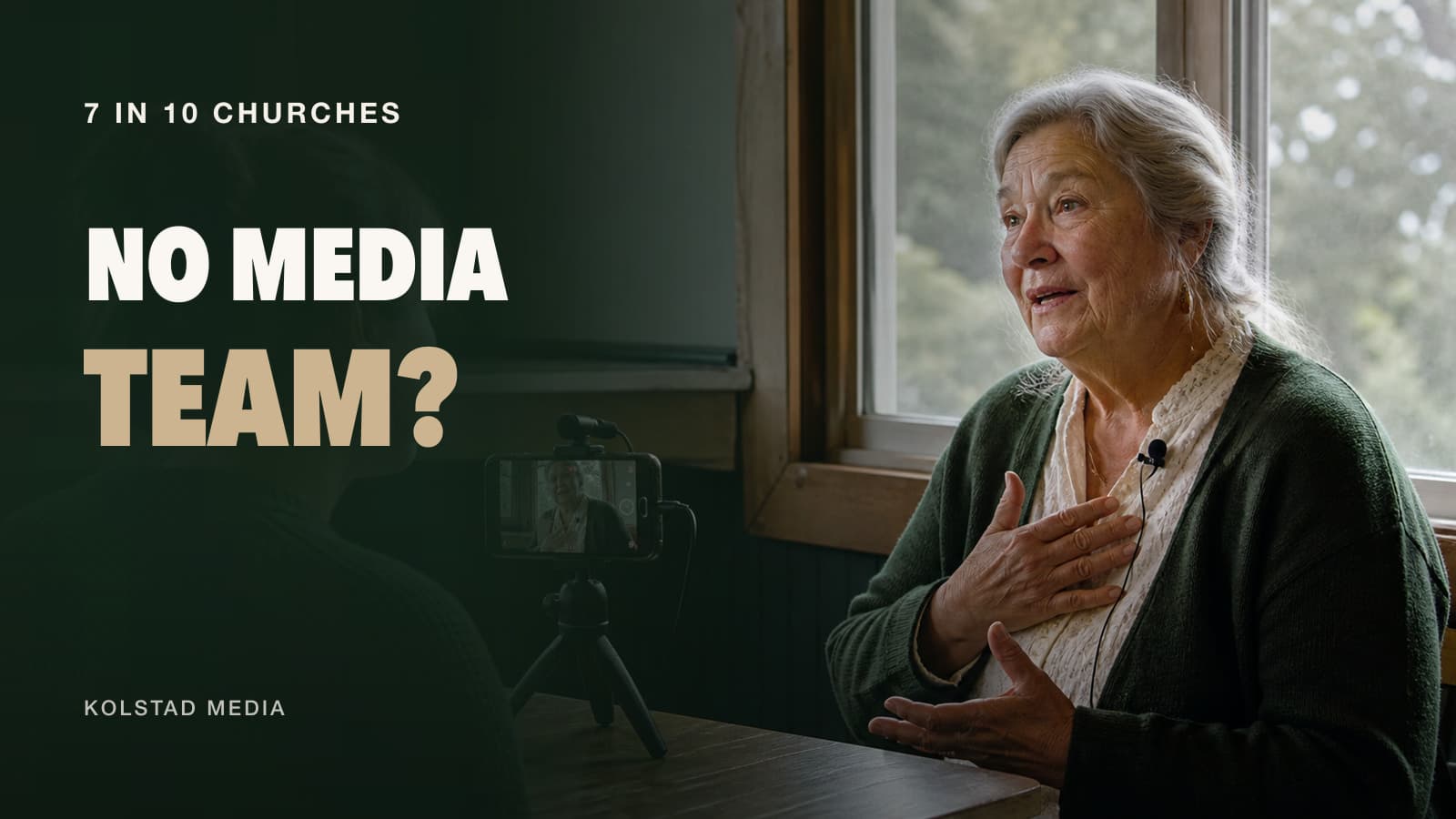
Every church I work with wants the same thing: more people walking through the doors. And at some point, someone on the team says, "We should make a video." They're right. Video is the most effective medium for reaching new people in 2026. The problem is that most churches make the wrong kind of video. They spend time and money on content that looks nice but doesn't actually move anyone to show up. So let me share seven church video ideas that I've seen work over and over again, the ones that actually translate into real attendance growth.
Before we get into the list, I want to set the right expectation. No single video is going to transform your church overnight. But the right kind of video, placed in the right spot and shared with the right strategy, can become one of the most powerful outreach tools your church has. I've watched it happen. I've helped make it happen. And I want to help you think about which type of video deserves your attention first.
Why Most Church Videos Don't Move the Needle
Let me be direct for a second. Most church videos are made for the people who are already there. Announcement recaps, sermon clips with no context, event highlight reels set to worship music. These are fine for internal engagement, but they do almost nothing to attract someone who has never visited your church.
The reason is simple: they assume context. They assume the viewer already knows your pastor, already cares about your building project, already understands your church culture. A person scrolling Instagram who has never set foot in your building doesn't have that context. They're asking one question: "Is this place for me?" If your video doesn't answer that question in the first few seconds, they're gone.
The church video ideas that actually grow attendance are the ones that speak to the outsider. They make someone feel something, understand something, or see themselves in your story.
The church video ideas that actually grow attendance are the ones that speak to the outsider. They're the ones that make someone feel something, understand something, or see themselves in your story. That's what we're going for here.
1. The Mission Film
This is the single most valuable video a church can have, and most churches don't have one. A mission film is a 2-4 minute piece that tells the story of who your church is, who you serve, and why you exist. It is a story rather than a commercial.
A great mission film usually features a mix of your pastor speaking from the heart (not from a pulpit, but in a real, unscripted way), real footage of your community in action, and one or two stories of people whose lives have been changed by being part of your church. It's cinematic. It's emotional. And it gives a first-time visitor everything they need to know about your community in just a few minutes.
Where it works best: embedded on the homepage of your website, shared on social media during outreach seasons, played at community events, and sent directly to people who inquire about visiting. This is the kind of project where working with a production partner who understands ministry makes a real difference. You can see examples of this kind of work on our portfolio page.
I've seen churches embed a mission film on their homepage and watch their visitor rate climb within weeks. People want to see what they're walking into before they show up. A mission film gives them that window.
2. The Sermon Series Teaser
A sermon series teaser is a short, punchy video (usually 30-90 seconds) that promotes an upcoming sermon series. Think of it like a movie trailer for your teaching content. It should create curiosity, tap into a felt need, and make people want to hear more.
The key to a great sermon series teaser is that it leads with the question, not the answer. Don't give away the sermon. Tease the tension. If your series is about anxiety, don't open with "The Bible says not to worry." Open with a scene that captures what anxiety actually feels like: the 3 a.m. spiral, the tightness in your chest when you check your bank account, the weight of trying to hold everything together. Then invite people to come hear the conversation.
"You should come to my church" is a hard ask. "We're starting a series on parenting this Sunday and I thought of you" is a much easier one. Sermon teasers give your congregation something specific to share.
These videos are gold for social media. They're short enough to hold attention, compelling enough to share, and they give your congregation a reason to invite their friends to a specific Sunday with a specific topic. That specificity matters. "You should come to my church" is a hard ask. "We're starting a series on parenting this Sunday and I thought of you" is a much easier one.
3. The Testimony Film
Nothing is more powerful than a real person telling their real story. A testimony film is a 2-4 minute video where someone in your congregation shares how their life has been changed, usually through their involvement with your church, a small group, a recovery program, or a personal encounter with God.
The trick is to tell it well. That means not just sitting someone in a chair and pressing record. It means spending time with them beforehand to identify the narrative arc. Where were they before? What happened? Where are they now? It means filming b-roll that brings their story to life visually. And it means editing it with care so the pacing feels natural and the emotional beats land.
Testimony films work because they're relatable. The person watching might not share the same exact circumstances, but they share the same core struggle: loneliness, grief, addiction, doubt, broken relationships. When they see someone like them on screen saying "I found a place where I belong," that's more convincing than any sermon clip or announcement video you could produce.
One word of caution here: tell these stories ethically. Make sure your subject is fully comfortable, fully informed, and not being pressured to share more than they want to. Vulnerability on camera is a gift, and it should be handled with deep respect. I wrote more about this in our piece on telling your story without exploiting people.
Want to see what these video types look like in practice?
Browse mission films, testimonies, and campaign pieces we've produced for churches.
View Our Portfolio4. The "Life of the Church" Recap
This one is different from a typical event recap. A "life of the church" video is a 1-2 minute montage that captures the full breadth of what your community looks like in action. Sunday morning worship, small groups meeting in living rooms, volunteers serving at a food pantry, kids laughing in the children's ministry, baptisms, prayer circles, community dinners.
The goal is to answer the question, "What does this church actually feel like?" Not what does the pastor say on stage. What does it feel like to be part of this community? The energy, the diversity, the warmth, the real-life messiness and beauty of it.
These videos work well on your website's "About" or "What to Expect" page. They also perform well on social media, especially when paired with a simple caption like, "This is what we're about." No hard sell. No call to action. Just a genuine look at the life happening inside your walls.
The production value doesn't have to be sky-high for this one. Authenticity matters more than polish. But the editing matters a lot. Good music, good pacing, and thoughtful shot selection can make a simple montage feel genuinely moving.
5. The Welcome Video for First-Time Guests
This is one of the most practical church video ideas on this list, and one of the most underused. A welcome video is a 60-90 second piece designed specifically for people who are planning to visit for the first time. It answers their biggest questions: Where do I park? What should I wear? What happens when I walk in? Where do my kids go? How long is the service?
It might sound boring, but it's actually one of the most impactful videos you can create. Visiting a new church is intimidating. People have anxiety about the unknown. A short video that walks them through what to expect, hosted by a friendly face (ideally your pastor or a welcoming staff member), can dramatically reduce that anxiety and increase the likelihood that they actually follow through on visiting.
Put this video on your "Visit" or "Plan Your Visit" page. You can also include it in an automated email that goes out when someone indicates interest in visiting. It's simple. It's practical. And it works because it makes people feel cared for before they even arrive.
6. The Staff or Pastor Introduction
People connect with people, not organizations. A staff introduction video gives potential visitors a chance to see the faces behind the church before they show up. This is especially powerful for the lead pastor, since for a lot of first-time guests, the pastor is the deciding factor.
Keep it authentic. Don't script it word for word. Let your pastor (or staff members) talk naturally about why they love what they do, what they hope people experience at your church, and a little bit about who they are outside of ministry. Hobbies, family, the stuff that makes them human. People want to see that their pastor is a real person, not a performance.
These videos live well on your website's staff page and on social media. They're also great for onboarding new members or helping people put names to faces in a larger church where it's easy to feel anonymous.
A well-produced pastor introduction video has an outsized impact relative to its cost. It can be shot in an hour and edited in a day, but it builds trust with potential visitors in a way that almost nothing else can.
7. The Generosity Campaign Film
If your church is running a giving campaign, a building project, or a special initiative, a generosity campaign film is one of the best investments you can make. This is a video that casts vision. It shows people what their generosity makes possible by telling the stories of lives already being changed and painting a picture of what's to come.
The best generosity films don't guilt people into giving. They inspire them. They show the tangible impact of the church's work: the family that got back on their feet through the benevolence fund, the student who found hope in the youth program, the neighborhood that's being transformed through outreach. Then they connect that impact to the opportunity in front of the congregation.
Vision first
show people what their generosity makes possible
These films are typically 3-5 minutes long and are shown during a service, at a special event, or shared digitally as part of a campaign. Their job is to make the vision tangible, connect the need to real people, and help a congregation understand what its generosity can make possible.
This type of project is where production quality really matters. The film needs to feel worthy of the moment. If you're asking people to give sacrificially, the video asking them to do so should reflect that level of seriousness and care. Working with a team that understands both video craft and ministry context is essential here. That's the kind of work we specialize in at Kolstad Media.
How to Decide What to Create First
If you're looking at this list and feeling overwhelmed, take a breath. You don't need all seven videos. You need the right one for where your church is right now.
| Your Situation | Start With | Why |
|---|---|---|
| No video content at all | Mission Film | Most versatile, evergreen, and foundational. Use it everywhere for years |
| Have a general video but few visitors | Welcome Video | Bridges the gap between online curiosity and in-person commitment |
| Upcoming sermon series | Sermon Series Teaser | Gives your congregation something specific and shareable to invite friends to |
| Launching a giving campaign | Generosity Campaign Film | Highest ROI: it's not just a video expense, it's a fundraising strategy |
If you don't have any video content at all, start with the mission film. It's the most versatile, the most evergreen, and it lays the foundation for everything else. You can use it on your website, on social media, in email, and at events. It tells your story once, and it keeps telling it for years.
If you already have a general church video but you're struggling to convert online interest into actual visitors, create the welcome video. It bridges the gap between curiosity and commitment by reducing the anxiety of showing up.
If you have an upcoming sermon series you're really excited about, invest in a teaser. Give your congregation something to share. Give the people in their lives a reason to say yes to an invitation.
If you're about to launch a giving campaign, the generosity film is your highest-ROI move. It's not just a video expense. It's a fundraising strategy.
Think strategically. Every church video idea on this list can work, but the ones that work best are the ones created with a specific goal for a specific moment. Match the video to the need, and you'll see results.
The point is: think strategically. Every church video idea on this list can work, but the ones that work best are the ones created with a specific goal for a specific moment. Match the video to the need, and you'll see results.
Bringing Your Video Vision to Life
The churches that are growing through video in 2026 aren't necessarily the ones with the biggest budgets. They're the ones that are intentional about what they create and how they use it. They pick a specific goal, invest in the right type of content, and then actually distribute it with a plan.
If you're a church leader reading this and you're ready to move beyond announcement videos and event recaps, I'd encourage you to start with one of the seven ideas above. Pick the one that matches your current need, set a realistic budget, and find a creative partner who understands your world. Find someone who gets the heart behind what you're doing, not only someone who makes pretty pictures and can translate it into a story that reaches people.
Video isn't a luxury for churches anymore. It's how people discover you, evaluate you, and decide whether to give you a chance. The question isn't whether your church should be using video. It's whether the video you're making is actually moving people from curiosity to commitment. That's the bar. And with the right church video ideas and the right execution, it's a bar you can absolutely clear.
Ready to create video that actually grows your church?
Let's talk about which video type is the right fit for your church's goals and budget.
Book a Free Discovery Call