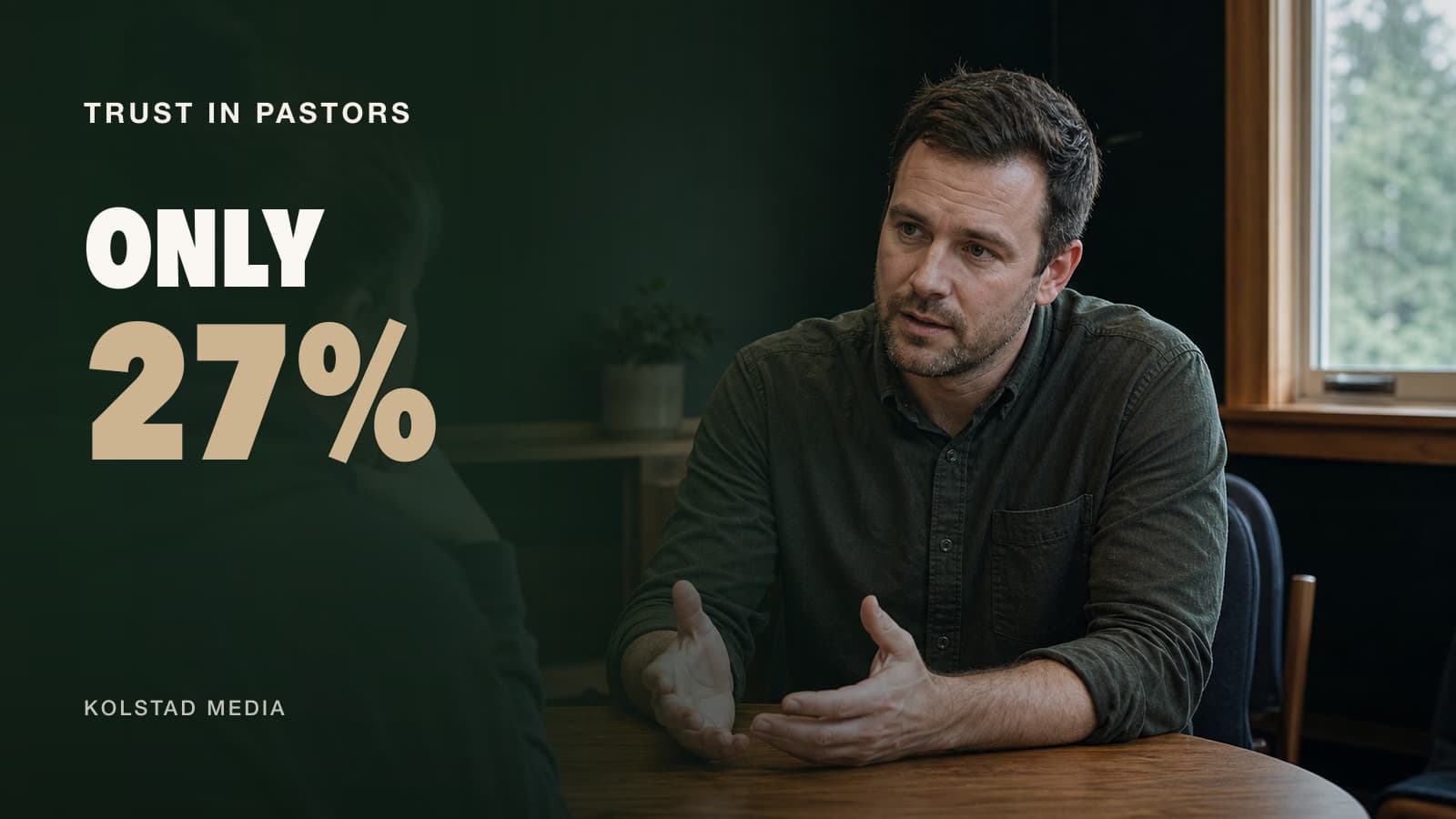
In January, Gallup released a number that should stop every ministry leader in their tracks. Only 27 percent of American adults say clergy have high or very high honesty and ethics. That is the lowest it has ever been. It was 30 percent the year before, and it keeps sliding.
Gallup has tracked 23 professions since the early 2000s. Of all of them, clergy have fallen the furthest. The average was 56 percent in the 2000s. Today it is 27. No other profession dropped like that.
27%
of U.S. adults rate clergy honesty and ethics as high or very high, a record low (Gallup, via Lifeway Research, Jan 2026)
I want to be careful here, because it would be easy to read that number and get defensive, or to get discouraged and quit. Neither one helps. So let me tell you what I think is actually going on, and then what I have watched actually rebuild trust in real churches.
The gap is generational, and it is wide
Break that number down by age and it gets sharper. Among adults 55 and older, 38 percent rate clergy honesty highly. Among adults 34 and under, it is 17 percent.
Fewer than one in five young adults gives your office the benefit of the doubt. Not your character. Your office. Before you open your mouth.
The older half of your community still extends trust based on your title. The younger half does not. They extend it based on what they have seen you do.
The number that surprised me most came from Barna, which found that nearly one in three U.S. adults now considers AI-generated spiritual advice about as trustworthy as guidance from a pastor. Among Gen Z and Millennials it is closer to two in five.
A chatbot. As trustworthy as a pastor. Not because the chatbot is wise, but because it has no track record to distrust. That should tell us something about where we are.
Why claiming trust does not work anymore
Most churches respond to a trust problem by making trust claims. New tagline. Values page. A statement about integrity on the website. A sermon series about authenticity.
None of that moves the needle, because trust claims are exactly what an untrustworthy organization would also make. Everybody says they are honest. The word has stopped carrying weight.
You cannot say your way out of a trust problem. You can only show your way out.
Trust is not built by describing your character. It is built by letting people watch it. Over time. In public. Especially when it costs you something.
What actually rebuilds trust
This is what I have watched work in churches and nonprofits across the Portland area and beyond. None of it requires a big budget. All of it requires being willing to be seen.
Let other people say it about you
Nothing you say about your church counts as much as what a member says about it. A 90 second story from someone whose life changed carries more weight than any statement you write. Stop being your own witness.
Show the work, not just the wins
Post the setup, not only the finished event. Show the volunteers stacking chairs, the food bank on a slow Tuesday, the small group that has met for six years. Ordinary and consistent reads as honest. Highlight reels read as marketing.
Be first and specific about money
Do not wait to be asked. Publish where the money went, with real numbers and real outcomes. Vague generosity language now sounds like hiding. Specific numbers sound like nothing to hide.
Put a real face on it, consistently
People trust people, not logos. The same faces showing up over months builds familiarity, and familiarity is the front porch of trust. One polished video a year does less than twelve honest ones.
Say the hard thing before someone else does
When something goes wrong, name it plainly and early. Every leader who has done this tells me the same thing. It cost less than they feared and bought more than they expected.

The advantage you actually have
Most local church leaders do not realize the trust collapse is uneven. National platforms, celebrity pastors, and huge institutions are taking the worst of it. Local, ordinary, present churches are doing better than the headline number suggests.
If you are a pastor at a church of 90 people in a normal town, you are not the problem the survey is measuring. But you are living with the fallout of it. People walk into your building carrying suspicion they picked up somewhere else.
You cannot fix the national trust problem. You can absolutely fix whether the people in your zip code have seen enough of your ministry to trust it. That is a communication problem, and it is solvable.
The work is showing people what is actually true about your church, repeatedly, in a form they will actually watch. Not claims. Evidence. Faces, stories, follow-through, and money you can account for.
Start with an honest look
Before you make anything new, look at what a stranger already finds. Pull up your website, your Instagram, and your Google listing on your phone, the way a skeptical 30 year old in your town would. Ask what a person who assumes the worst about churches would conclude in 60 seconds.
Most leaders find the same thing. Their ministry is far more trustworthy than its public evidence suggests. That gap is where the work is.
We built a short audit for exactly this. Twelve questions, about twenty minutes, and you will have a clear list of what to fix first. It is free and there is nothing to buy at the end of it.
Get The Trust Audit and see what a stranger actually sees when they look up your ministry.
Get the Free Trust AuditOne last thing. If the 27 percent number discouraged you, remember what it is measuring. It measures reputation, not faithfulness. Those are different, and only one of them is in your hands this week. Keep doing the quiet, ordinary, faithful work. Then let people see it.